Showing posts with label Hollywood. Show all posts

Sunday, April 04, 2010

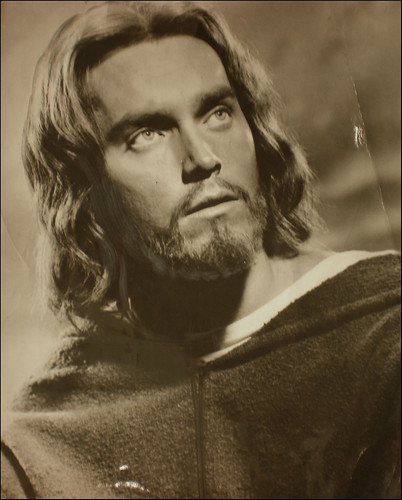
The Biblical Spectacle of Clean Clothes

It is wondrous and reassuring to know that the citizens of Biblical times were able to wear beautifully washed and pressed clothing.

Easter Weekend on Turner Classic Movies has presented an endless succession of seasonal classics about various religious figures running aground on the shores of the ever-strict and intolerant Roman Empire.

Despite the best efforts of Roman Soldiers in shiny armor to do them harm, the heroes of these Bible stories re-told manage to keep their togas and robes wrinkle-free and smelling, undoubtedly, like Fabreze.

One can only imagine the laundries of those far away times complete with washer-women of indeterminate race who rubbed and scrubbed and then took their flat cast-irons to the robes and pressed them out flat and shiny, starch on the collars, please.

No self-respecting Biblical character, after all, would be caught dead in dirty wrinkly clothing, especially not those of the ruling classes who needed to keep up appearances in order to oppress their victims with impunity and the proper disdain of superior beings.

Clearly, Hollywood spared no expense in researching the daily life of the poor in the Middle East. Let's ignore, for a moment, that authentic Arabic peoples tend to be short, dark-skinned and bearded: the likelihood of tall, blue-eyed exquisitely coiffed characters being marginal at best. But the short, dark-skinned acting pool in Hollywood must have been minimal, and it was, undoubtedly, easier to cast all those tall attractive people.

Then, of course, real history is always a little messy, what with the need for real people to take care of toilet matters in circumstances with little or no running water and a marked scarcity of pull-chain, flushable toilets.

But the appearance of the movie characters must match the cleanliness, grammar, and elocution of their well-constructed dialogue and those gloriously crafted speeches sound better coming from the lips of those tall, blue-eyed performers than they would from drooling mouths of scraggly runts.

There you have it then: Biblical authenticity with the cleanliness of a German HausFrau, the beauty of the best of Central Casting, and the fine, well-chosen words of the college educated. Clearly, the framers of the original Bible were just doing the best they could with limited means. We dare not blame them.

As Hollywood, MGM, Warner Brothers and all the other brothers (and possibly sisters) of the film making community now and then would like us all to know, Cleanliness IS next to Godliness. Thank you, Hollywood.

Wednesday, March 16, 2005

Orson Welles A One Man Band

What I most remember about meeting Orson Welles was that he was big and also smiling. I managed to go up to him after a talk he gave at the Director's Guild of America in Hollywood sometime in the very early 80's. He showed some black and white excerpts from "The Other Side of the Wind," and I remember that he said something to the effect that if you took the boxoffice grosses of all of his movies including Citizen Kane and added them together the total would barely come up to the budget of a modern film. That was 15 years ago. And he was right.

In 1975, I was working on a documentary about American Comic Book and Comic Strip artists and I wanted to include an interview with Orson Welles. According to Jerry Siegel, the original delineator of The Joker in Batman comic books and a neighbor of mine, the guys around the comic book offices back in the early 1940's were big comic book fans! This included people you've probably never heard of, but should have, like Will Eisner, and some you have heard of, who you probably should ignore, like Bob Kane. Anyway, these guys liked to go to the movies. And they especially liked real moody black and white cinematography of what came to be thought of as the Gregg Toland school of perhaps even "noir" later on. They'd go see a movie, then come back to the office and draw it into their comic books. If you want to bother to look at the very early Batman and Detective Comics, you'll see it all there: shadows, dutch angles, silhouettes, you name it.One day somebody came back from a certain movie and told everybody else and they all went to see it and they came back and verbally slavered over it and drew it into their comic books. It was Citizen Kane of course and you can see the influence of that, too, especially in Wil Eisner's work up to the present day: both graphic style and story-telling style. Check out Dropsey Avenue or A Message From God.

So, now. Somebody actually talked to Orson Welles around about that time and found out that he (and apparently Gregg Toland) loved comic books. That he had been an avid reader of Detective Comics and Batman and had deliberately made Citizen Kane look like that. !!!!

Peter Bogdanovich was nice enough to give me Orson's home phone number in Los Angeles, and said "Call him up. Either he'll answer the phone or he won't." So I did. And Orson never answered the phone.

This evening I watched a lovely documentary about Orson's "declining" years down at the Film Forum, and thankfully there were more than the 5 people there that a friend reported a few days ago. Most of the audience was young. They laughed at the jokes though, and they were attentive. Not as many as I laughed at. That's because I'm older and more jaded and have more tire marks from Hollywood across my back than they do, but perhaps I'm putting on airs.

When I went up to him 15 years ago, I think I wanted something to rub off. I didn't know just what to say, and I believe I shook hands with him. Maybe not, but I think I did. I was awed, and in retrospect I felt a little like the guy in the color excerpt from "Wind" who goes up to John Houston and says "I'm Joe Blow." And Houston replies, "Of course you are." I'm sure I identified with Welles. Maverick. So did all umpty hundred people in the audience at the interview shown in the film. Oddly, they all probably wanted to be him. I know I did. I haven't gotten close, but I've suffered some of the same indignities. It's just that the detritus of my life isn't quite as interesting as the detritius of his. And the biggest thing I ever did, is awful tiny compared to the smallest thing Welles pulled off.

New York City, December 23, 1996