Saturday, March 12, 2011

Genuine Cookie Fortunes: Number One of an Infinite Series

Chinese Fortune cookies often contain astonishing pronouncements.

From time to time they will be quoted here exactly as found within the original cookie.

Number One:


Only listen to fortune cookie,
disregard all other fortune telling
units.


LEARN CHINESE - Eggplant
qie(2) zi(2)
Lucky Numbers 46,26,50,45,56,49

Tuesday, December 21, 2010

George Pal, Logan's Run, MGM and Wikipedia gets it wrong (again)


George Pal (War of the Worlds, When Worlds Collide, Seven Faces of Dr. Lao) was the first movie producer to attempt to make Logan's Run. According to Wikipedia, however, Pal doesn't exist. Even in the "official" Wikipedia bio, http://en.wikipedia.org/wiki/George_Pal , the notation for Logan's Run requests a citation.

The problem, of course, about anecdotal evidence is that even if you are the one who George Pal told the anecdote to, nobody believes you because Pal is long gone and can't smile and say "Oh, yes, that's true!"

Now Bill (William F.) Nolan is still alive, and thanks to him and Sunni Brock (who, at my request, asked Nolan for the "truth") we have our verification.


And I quote:

“Pal was the first producer, at MGM, to option Logan’s Run for filming. Pal was ready to shoot the film in Brasilia – it’s an ultra-modern city, they were relocating the capitol. Pal was using the book’s 21-year death age, but before he could get it to production, his option at MGM ran out. Pal’s choice for the screenplay was to be written by Richard Maibaum, the 007 writer.”

In the late 19s0x, Pal told me how disappointed he was that the he never got to make the film. One can only suppose that it might have been a much better film than what we got. Pal was a meticulous guy, and I'm only guessing, of course, but his vision of the future would have been pretty interesting.

It's always harder to get films started than anyone thinks in this era of narcissistic digital movies and the great "I'll write a screenplay and get paid $3 million bucks" sweepstakes entered by anyone who thinks they can spell.

So, Wikipedia, now you have your citation. I hope someone will add it in and that the Fascist editors at Wikipedia won't delete it for lack of "verification."

Wednesday, October 13, 2010

Mr. Popper's Penguins

All these years I've wanted to make Mr. Popper's Penguins into a "major motion picture," but was never in the position to do so. Now it is added to my endless list of "projects I wanted to make that someone else did instead."

Robert Lawson is, in many ways, the star of this book, and it was absolutely his drawings that have kept me glued to the idea for so long.

Of course, we've now reached a level of CG that makes it possible to animate hordes of "penguins" that look just like the living, breathing, real thing. Heretofore, teams of penguin trainers would have been necessary, thereby rendering the project too expensive, too difficult, nearly impossible.

Born too soon.

Sunday, August 08, 2010

Hello?

How strange to think that no one really reads this.

Breezes

Sometimes in the night, when it is very still, there are tiny breezes that don't move the leaves, but still stir the soft hair on the edge of your ears and cool your heart.

Sunday, July 18, 2010

The Profound Illiteracy of Facebook and the Web. Don't miss the Canon Shooting!

One of the not entirely unexpected revelations of the endless posts on my Facebook wall, is just how the grasp of the English language by friends and acquaintances has disintegrated. Judging by the near non-existence of proper spelling, grammar and punctuation, one might conclude that we are all suddenly living in the late 19th Century before the advent of Public Schools and education and dictionaries despite the spectacular availability of online resources and spell checkers.

Creative spelling is astonishing as is the equally adventurous ignorance of punctuation.

Here's a "sentence" (paraphrased so as to disguise its origin) that comes directly from a FB post.

time to learn my part I'm performing tomorrow!!!

Now this could be interpreted in a number of ways.

1) It is now time to learn my part which I am performing tomorrow.
2) There is time to learn my part which I am performing tomorrow.
3) It is now time to learn my part. I am performing tomorrow.
4) There will be time to learn my part. I am performing tomorrow.

I sort of think number (3) was intended, but without talking to the person, I have no idea.

I'd be tempted to write it as:

It is time to learn my part: I'm performing tomorrow.

From a journalistic viewpoint, this is highly speculative, but, hey, you've got to take a chance sometimes.

I've changed "I'm" to "I am" since the extravagant use of apostrophes (and commas or the non-use of apostrophes and commas) is a new aspect of modern creative writing.

The favorite trope is the addition of an apostrophe to nearly everything that has an "s" at the end of it.

The previous sentence using this remarkable linguistic revelation would include:

"... the extravagant use of apostrophe's... " to indicate more than one apostrophe. [If there was such a thing, it would be correct to say that "I am visiting the apostrophe's new house."]

The distinction in the mind of many between possessive and plural has vanished in the wake of the eradication of the distinction between "less" and "fewer." Perhaps this has to do with some unknown additive to highly sugared breakfast cereals (or is that cereal's ?) or some other more pernicious plot. Oops. Sorry. That's "perhap's" and "Oop's" isn't it? Or is it Thats' perhaps's and oops's, ain't it?

"I went to visit the Smiths" becomes "I went to visit the Smith's." If it was "I went to the Smith's house" all would be well, but this puts us back into the realm of speculative journalism.

There seems (ummm seem's) to be no cure for all of this. All of my friends (er... friend's) in the educational professions (ahhh... profession's) tell me that high school students and college students come to them unable to write clear sentences (sentence's). Instead of advancing the knowledge of students, these hapless educators slave at getting the kids to disentangle themselves from their IPods and smartphones long enough to consider history or philosophy or home economics. (Do they actually teach Home Ec any more? I wonder.)

I'm going to go right out on a limb here and state the obvious. The majority of this linguistic chaos originates with texting. Now just why any sentient being would want to spend more than a nanosecond informing another sentient being that "hey whoa it rocks" in the midst of watching a movie or eating or taking a dump is totally beyond my compreshension. But, hey, whoa, different strokes... .

The need to contract words so that one's thumbs don't fall off from exhaustion is crucial. T nd 2 contct wds sew tht my thmbs r stil hr iz imptnt. Or something like that with the addition of lots of smileys and other strange symbols alien to my aging eyes, but highly meaningful to those under 12 years old.

There is more at stake here than the generation gap: The continuity of civilization depends upon the communication of various forms of knowledge.

There is a genuine difference between "It's here" and "Its here." The former means "It is here," the latter means "This 'here' belongs to It" (whatever that means).

A sign in the New York City Subway reads "Haircut's." Haircut's what? The Haircut's dog? The Haircut's life insurance policy? You can argue that everyone knows what they really meant. I can argue that this requires lots of unnecessary speculation and that it panders to ignorance.

Indede y bother spelin nething kurectlee in the furst plaze. We kin awl figyour owt whut I mene neeeway, kan't weee?

The world has not collapsed yet, but when I view a subway car full of grown people so plugged-in to their electronic devices that they don't even notice where they are, that they are shoving their backpack into the eyes of some hapless old lady who is blissfully IPod free, that they miss their stop and curse because they weren't paying attention, that they stand in the middle of the door unmoving because they are so involved in whatever music is playing far too loudly into their ears that they haven't noticed that the door is open, that the chime is ringing, that seven people are trying to shove them out of the way to escape, and then, that it's really everyone else's fault for interrupting, bothering and annoying them!

Steve Jobs and colleagues have provided the world with the finest excuse in centuries for rudeness, inattention, small-mindedness and unnecessary redundancy of function with those cute little IPhone thingies. A great, elegant toy. A great, inelegant time waster. A great distraction from the reality of where you are. If you looked up from your smart phone for just a moment, you might see where you are instead of having to call up a GPS application that pings three satellites in orbit around the earth, pings your phone back and displays a map that shows you where you already should have noticed that you were standing in the first place. (Okay, it is convenient to be standing on a strange street corner in heaven only knows what country, to be able to push a button and find out how many steps you need to take to reach the nearest McDonald's. Don't know how I lived for decades without it).

My favorite Facebook malaprop this week is a notice for the "Canon shooting" as part of a Pirate Week Celebration. One wonders what crime the poor Canon committed to be shot! Was it Pachelbel's Canon? Whatever did Pachelbel do to deserve this? Obviously, they meant "cannon," didn't they? But this is an event put on by a government agency and promoted by, oh I don't know, the agency director's sister's son's girlfriend fresh out of fourth grade. I'm pleased to know, in retrospect, that pirates were deeply into Canons. It shows that they were not all lowly, child-raping, thieving scumbags. Some of them appreciated the finer things as they pillaged and burned with their IPods blasting in their ears.

Sew, eye xstole tha vertewz uv lerning how 2 spel ahnd punkyewweight if ownlee owt of consideration to us awld fokz hoo r stuk withe Inglush az it yewst 2 b b4 yew kreeyaytive kidz fixed it 4 us awl. :-)

Oh, wait! I'm sorry. I forgot the punctuation.

S'ew, eye xstole, tha vertewz uv lerning, how 2, s'pel ahnd punkyewweight, if ownlee owt of consideration. to us awld fok'z!!! hoo r, stuk, withe Inglush, az it yew'st 2 b, b4 yew kreeyaytive kid'z, fixed it 4 u's awl !!!! ;-) :-D :-P~~~

That's better, isn't it?

Thank you.

Friday, July 02, 2010

The Days the Earth Stood Still: 1951 and 2008


The 2008 remake of The Day The Earth Stood Still (a 1951 masterpiece) was not as terrible as I imagined it would be, but it is a pale shadow of its predecessor.

It's interesting to note that the newer version credits the Edmund H. North screenplay as a source, whereas the 1951 film is based in part upon Harry Bates' short story "Farewell to the Master." (full text at http://thenostalgialeague.com/olmag/bates-farewell-to-the-master.html ). North elegantly riffed on the original and made it a strong and affecting cautionary meditation on the cost of war and violence. Sad to say, despite its high-tech CG effects, and more than a few "moments," the 2009 update never achieves the power of North's work.

Perhaps if I hadn't seen the original so many times, I would have spent less viewing time comparing the two, but we are what we are, and I couldn't help but do that. There's no question that David Scarpa managed to re-frame North's scenario in terms of the modern American military, modern technology and a sketchy, not terribly offensive version of the United States goverment. In 1951, for example, Klaatu simply walks out of the hospital where he is being kept under what seems today like minimal security. It was as though the average citizen would have simply honored the uniform and side-arms and not bothered to try to escape. Not so with the new Klaatu. He is kept under high-tech, computer controlled lock and key which requires that he use his extraterrestrial powers to jam video and audio surveillance systems, deafen and knock out myriad layers of security guards, pick electronic locks on the fly and generally avoid all sorts and kinds of impossible to defeat systems. All of this is plausible and rather clever and exciting, but, in the end it misses the point or dilutes it so badly that in the end it's just a lot of sound and fury.

It's awfully hard to put my finger on what's not right about the Scarpa retelling, but I think it has to do with the aforementioned "average citizen." It had always struck me that the original had the look and feel of a newsreel, and Robert Wise indeed confirmed that to me: he'd intended the film to play like what we would now call a "documentary." It had a simple photographic and editorial style that echoed what the average moviegoer would have seen each week in the black and white newsreels of the day including commentary by actual radio announcers. (Prior to the 24/7 coverage of the every twitch and flatulent sound of every world leader on CNN and the Web, each of the major film studios, but especially Fox and Universal, turned out a 10-12 minute "newsreel" that summed up the major breaking stories of the day with on-the-scene movie footage that augmented what people read in the newspaper or heard on the radio. There are, in fact, wonderful moments in the 1951 DESS with the rooming house boarders sitting around the breakfast table earnestly reading the Washington DC newspaper in order to find out what was going on in the world).

North tells his story through the reactions of these average folks to extraordinary events simply and sincerely. The Scarpa script instead uses the literal internet to show what people world wide are experiencing, but -- although authentic and visually clever -- it lacks emotional and human connection. That, indeed, may be one of the tragic by-products of the web itself: many of us (and apparently the current screenwriter) have lost touch with genuine face-t0-face human communication. Instant messaging and YouTube and blogs will never replace handshakes, conversations, deep meaningful eyeball to eyeball glances or real hugs and kisses. The 2008 film reproduces the cold, impersonal, arms-length modern world only too, too well.

Perhaps 1951 was a simpler more innocent world. I doubt that really, but the realities of military life, inter-continental communication and transport, and technology were certainly less sophisticated, varied and complicated than they are today. To be true to 2008, one must show it as it is.

The original Gort was about 7 feet tall, the new Gort is 70 or 700 feet tall (I don't really know how tall he is, but he's very, very tall). Yet, the itsy bitsy original Gort is mighty scary and ominous and the big tall Gort just looks like yet another slick Video Game robot. We have little emotional connection to this character. In fact, Scarpa (or someone) decided that G.O.R.T. was an acronym instead of a name. Gort like his namesake Gnut in the Bates story was a real character, not a throwaway piece of electronics. The audience cared about what he did, what he might be thinking, what he could do: The signature 1951 dialogue "Gort, Klatuu barada nicto" was absolutely all about Gort as a character, not Gort as an abstract idea or a clever visual effect.

By compressing the drama down to a basically three character story (Klaatu, Helen, and her son Jacob), Scarpa acheives a certain economy that allows lots more time to show nifty CG effects. But it loses the relationship to "every man," to the down to earth man on the street so lovingly set out in North's screenplay and Wise's incisive casting. The 1951 film is all the more terrifying, suspenseful, funny and heart-breaking for the foibles of people that, aside from the sort of clothes they wear and minor affectations of speech, we would recognize as people we know today. I just can't help thinking (perhaps unfairly given the homogenization imposed on so many scripts by studios) that Mr. Scarpa spends far too much time on Facebook and MSN Chat and far too little time sitting and talking to people or getting drunk in some low-life bar where he could hear directly about the petty, debilitating pain of the underprivileged. The montages of the Robert Wise film showing peasants and rich people alike all over the world paralyzed and terrified by the events of the story are eerie and affecting even today. There is no similar moment in director Scott Derrickson's (or the studio editor's) take on all this. While it moves along okay, I could have cared less.

And then there is Bernard Herrmann's score. It's a cliche to praise it as one of the greatest motion picture scores ever composed, but it is true. No offense to Tyler Bates who does good work as a composer. It's just that Herrmann was one of a kind: we will not see his like again. And his score for The Day the Earth Stood Still is one of a kind as well: there will be no other that achieves what this score achieves. It is one with the movie just as Herrmann's score for Psycho is married to that story as well. Herrmann's genius, perhaps, was in the way that his music became an active character in the story telling. Unlike the symphonic, operatic, program music style of Korngold and Rosza which wrapped the story in warm, Wagnerian layers of sugary emotion, Herrmann's music shed all the calories and acted both in counterpoint and to create information that didn't exist in the movie itself. Watch, for example, just the opening title sequence of DESS first without the sound and then with it, and you'll immediately understand what's added: it's rhythm, suspense, mystery, emotion, but all in a subtle and unexpected way with startling instrumentations and sounds that were otherwise non-existent in mainstream music of his day. YouTube Video

I'm not entirely sure what the message of the newer film is. I took it to be saying that humans were polluting their world uncontrollably (although some reviewers I've perused seem to be obsessed with the notion that Klaatu is destroying the world because humans have caused global warming which, they go on to say isn't real anyway as every Fox News Channel watching viewer would already know) and that this was not good form for sentient beings. North, on the other hand, was all about human violence and the threat of carrying wars, idiosyncratic destruction, and nuclear weapons into space where it would harm other more advanced, peaceful civilizations.
Sadly, North's message is as true today as it was 60 years ago: the behavior of Iran in 2010 is identical to the sort of thing North warns us about in 1951. The average citizen of this or any other country was well aware of atomic weapons in 1951: they were frightened by them in a way that perhaps modern citizens -- accustomed as they are to remote-controlled drone weapons that zip around like so many video-game toys -- may no longer be. The every day reality of nuclear annihilation has been pushed from our minds by information overload.

This brings me back to the risky notion that 1951 was a "simpler time." I reject that. No historic time was ever simple. But at any moment in history certain ideas and events stand out in more relief. Polio was not cured in 1951 and atomic bombs and spies lurked in every shadow. The Robert Wise/Edmund North/Bernard Herrmann Day the Earth Stood Still had all of those terrifying shadows faithfully reproduced. When I saw it as a small child, it frightened me in an indelible and, to its credit, constructive way: I never forgot the film and became (perhaps shamefully) a wee bit obsessed with its craftsmanship and message. It will be a long time before I think I'll be moved to dig out the 2008 version to watch it again, but having just watched a few clips from the original on YouTube in the last hours, I can truthfully say that I can't wait to watch the whole thing yet again. It pulls me in everytime.

I've been exploring, in other essays, some sort of practical definition for "masterpiece" in the context of motion pictures. A troublesome, slippery word. But one quality that jumps out at me is the magnetic pull of the great films. You can turn them on, tune in to the middle of them, hear them from the next room, and before you know it, you have stopped washing the dishes or typing in your blog or Instant Messaging, and you find yourself sitting absolutely still and watching the whole movie yet again. You just can't help it. Excuse me, but I want to see what happens to Klaatu...

Friday, April 30, 2010

Warm Feet

There are few things as wonderful as warm feet in cold weather.

Sunday, April 04, 2010

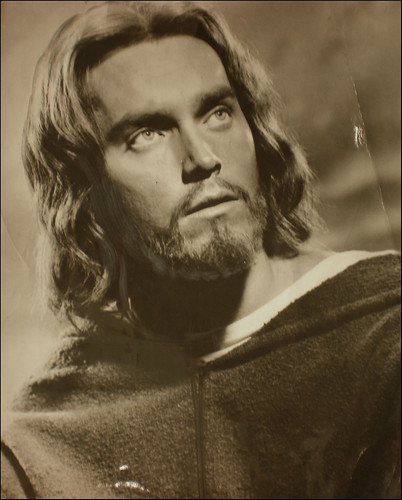
The Biblical Spectacle of Clean Clothes

It is wondrous and reassuring to know that the citizens of Biblical times were able to wear beautifully washed and pressed clothing.

Easter Weekend on Turner Classic Movies has presented an endless succession of seasonal classics about various religious figures running aground on the shores of the ever-strict and intolerant Roman Empire.

Despite the best efforts of Roman Soldiers in shiny armor to do them harm, the heroes of these Bible stories re-told manage to keep their togas and robes wrinkle-free and smelling, undoubtedly, like Fabreze.

One can only imagine the laundries of those far away times complete with washer-women of indeterminate race who rubbed and scrubbed and then took their flat cast-irons to the robes and pressed them out flat and shiny, starch on the collars, please.

No self-respecting Biblical character, after all, would be caught dead in dirty wrinkly clothing, especially not those of the ruling classes who needed to keep up appearances in order to oppress their victims with impunity and the proper disdain of superior beings.

Clearly, Hollywood spared no expense in researching the daily life of the poor in the Middle East. Let's ignore, for a moment, that authentic Arabic peoples tend to be short, dark-skinned and bearded: the likelihood of tall, blue-eyed exquisitely coiffed characters being marginal at best. But the short, dark-skinned acting pool in Hollywood must have been minimal, and it was, undoubtedly, easier to cast all those tall attractive people.

Then, of course, real history is always a little messy, what with the need for real people to take care of toilet matters in circumstances with little or no running water and a marked scarcity of pull-chain, flushable toilets.

But the appearance of the movie characters must match the cleanliness, grammar, and elocution of their well-constructed dialogue and those gloriously crafted speeches sound better coming from the lips of those tall, blue-eyed performers than they would from drooling mouths of scraggly runts.

There you have it then: Biblical authenticity with the cleanliness of a German HausFrau, the beauty of the best of Central Casting, and the fine, well-chosen words of the college educated. Clearly, the framers of the original Bible were just doing the best they could with limited means. We dare not blame them.

As Hollywood, MGM, Warner Brothers and all the other brothers (and possibly sisters) of the film making community now and then would like us all to know, Cleanliness IS next to Godliness. Thank you, Hollywood.

Sunday, March 14, 2010

Adverbs and Adjectives

Actually overheard in a University Classroom:

Professor: If an adverb modifies the verb, what does an adjective modify?

Student: The "jective."

Friday, January 22, 2010

Things That Have Vanished From the World #2: Books Flush to the Edge of Book Shelves

Once upon a time, there was a certain way to keep books upon a shelf: All of the spines were lined up carefully so that they sat flush along the front edge of the shelf in a nice neat line. Each spine of each book flowed smoothly into the next, making a flat wall of books. Each title of each book was easily readable as your eyes scanned along them. It looked, and it was, orderly.

Today, however, visit a Barnes and Noble brick and mortar bookstore and you'll find the books shoved to the back of the shelf, the page side lined up, and the spines ragged and leering out at you like angry teeth desperately in need of braces.

There were reasons for lining the books up. It looks nice to begin with. It makes the titles easy to read. And it makes it easy to get the books off the shelf to read them without breaking the spines of clothbound books.

Now there are reasons for not lining the books up. Laziness. Bad examples. Bad training. Ignorance. And the idea that it's easier and faster to do that. Oh, that's just another name for laziness, isn't it.

I once asked a young lady why she was pushing all the books to the back of shelf. She said it was faster. I said it wasn't. She looked skeptical. I stepped over and pulled an entire shelf of books to the front edge of the shelf and evened them off with the palm of my hand in just a few seconds. She looked astounded. Bad examples. Bad training.

No one cares anymore.

Thursday, November 26, 2009

Things That Have Vanished From the World: #1 Stars in Dark Night Skies

50 years ago, you could look up at the night sky and see stars.

The sky was black. B L A C K

And the stars were bright white.

You could see LOTS of them. Including the Milky Way.

Now, you can only see a sort of amorphous fog with a glint of something that might be a star fighting through the misty mush.


Monday, November 23, 2009

Mass Transporation: Salvation for America

The destruction of mass transportation in the United States throughout the last 50 years of the 2oth Century is undoubtedly a key factor in the decline of that country. Only its restoration and reinvention will bring back desperately needed and healthy cities.

Putting aside the folly of white-flight from the inner city to the suburbs, and noting soberly the contribution of the automobile (and its promise of freedom and mobility) to the creation of suburban sprawl, the loss of light rail (trolleys and trains) and reliable and regularly running interlocking bus systems is central to the isolation of the suburban dweller, to the oil and fuel crises that grip the world, and to the disintegration of community.

Only fifty years ago, neighborhoods across North America contained all the necessary businesses (groceries, hardware, movie theaters, shoe makers, specialty stores) within walking distance. Those that were not quite within walking distance could be reached quickly and easily with light rail systems that ran regularly and between all the adjoining urban areas. Only New York City, Boston, Chicago, Washington, D.C., San Diego, and San Francisco contain vestiges of this functional and benevolent system. Some might classify the NYC system as different from true "light rail," but for these discussion purposes they are interchangeable. Fragments exist elsewhere: Los Angeles, Buffalo, NY, Portland. Wikipedia claims only 20 U.S. cities have significant light rail.

Europe and Asia contain hundreds of such systems. Rail is everywhere, carrying passengers between urban districts and other countries cheaply and swiftly. The automobile is a luxury and, to a great extent, an indulgent inconvenience.

New York City's transportation system offers "carless" transportation to virtually anything within Manhattan and the major boroughs. There are those who take Taxi cabs, but it is a curious luxury, a convenience to the disabled, and often less efficient than subways (though usually faster than buses.) The commerce of Manhattan would fail without the rail systems. Through a combination of walking and riding, visitors and residents can get anywhere they want to in very short periods of time.

Los Angeles, by contrast, has become a 24/7/365 rush hour with wall-to-wall cars carrying single passengers through grueling and time-consuming trips for essentials that could once have been purchased at a corner store or supermarket and that now have to be retrieved from huge food stores that are often 10 miles away. Without a car, people would -- literally -- starve.

It affects culture as well. The city of Buffalo, NY, like many others, was filled with wonderful neighborhood movie theaters. Within a five or ten block radius, residents could take a leisurely walk to one or more single-screen movie houses any time they wanted. That city is now dominated by 14-20 screen multi-plexes that lie four to six miles (or more) from any suburban neighborhood. It's no wonder that film-going has declined nationwide: it's far more convenient to stay home and watch television than to travel those distances for an expensive treat (accompanied by even more ridiculously expensive food). People remain at home -- isolated from large social groupings -- entertaining themselves with home theaters, the internet, video games and other solitary pursuits.

Only churches, sports events, special movies, and occasional rock concerts bring large groups of people together in most smaller cities and suburbs. New Yorkers (for better or worse) are surround by people constantly and shop amongs hundreds of fellow human beings. This is, without a doubt, a contributing factor in the "melting pot" effect of life in large cities. Europeans and Asians experience a similar mixing and crowding daily.

Recent discussions of high-speed rail are extremely promising. New York State is a great candidate for this as is California between Los Angeles and San Francisco. Either of those routes equipped with high-speed trains would eliminate inefficient and often unprofitable short distance plane service. With New York City as a hub, all of the North Eastern United States (and Eastern Canada) would be linked easily with a radial high speed system connecting Washington, Philadelphia, NYC, Boston, Montreal, Buffalo, Niagara Falls, Toronto and Chicago and all the points in between. The train ride from Chicago to NYC which now takes about 12 hours would become a 5 hour trip. NYC to Albany would take less than an hour by train. At those lengths, trains become a far more attractive alternative to crowded, uncomfortable planes.

There seems to be no feasible solution for the plague of pollution, fuel shortages, non-existant community cooperation until mass transportation is restored. None.

Rendezview

Rendezview:

To get together to watch a movie (or movies).


Sunday, November 15, 2009

Thursday, November 05, 2009

The CCCC Principle

An interesting quotation follows.

" Science reinforces my manager's notion with something called Krause's Hypothesis or the CCCC Principle ("Complete competitors cannot coexist). Howard Ensign Evans in Wasp Farm explains it this way: "The theory behind is that if two species do in fact do everything alike--live in the same place, feed on the same food, and so forth--one of them is bound to do something very slightly better than the other and will, over a period of time, completely eliminate the other."

Here, you'd better open your notebooks, because Mr. Evans goes on with a piece of advice to beleaguered species, and if you're having a little trouble you may wish to note it down: "But if in fact they impinge on their environment just a little differently in some respect, they can coexist indefinitely."

There is a world of useful advice for all of us in that sentence. If, for example, you are a welterweight fighter who is being completely eliminated, you might think about taking on lightweights. If you are an actor who finds too many living in the same place and feeding on the same food, you might try directing or producing or becoming, as one actor did, the governor of California. "

A Studied Madness by Heywood Hale Broun, Second Chance Press, 1979, Pages 266-7


Wednesday, August 26, 2009

Wikipedia and Me. Some Kind of Affair, but is it Love?

Through the kindness of strangers some fragments of what you might vaguely describe as my life have found their way onto Wikipedia.

This has not been without incident, however, as those wonderful nameless editors seem to constantly pick at the facts based upon their Googling of the vast depths of the internet. Unfortunately, those depths are not as deep as real life, and often they catch no fish because the objects of their desires are buried not in cyberspace, but in books, magazines, archives and personal recollections.

In the wake of an announcement that Wikipedia will begin to fuss with the biographies of living people and since, as near as I can tell, I'm still living, I can only assume that they will want to fuss with me as well. They've done it before and I expect them to do it again.

I'm posting below the current Wikipedia entry for myself with the positive assertion that to the best of my knowledge it represents (albeit in a rather skimpy form) things that really happened in my life. I've been astonished to find that -- having read this -- total strangers have gotten in touch with me because they, too, recall the people, places and events recounted on Wikipedia. One point for them.

This may not be the Good Housekeeping Seal of Approval, but it is the Edward Summer Seal of Approval. Everything you read below is true as far as it goes. There's much more to it of course and perhaps there is some way for me or someone to fill it in better.

It's all very flattering that it exists and it's posted here with embarrassment in order to affirm its validity.

Feel free not to read it.


Edward Summer
From Wikipedia, the free encyclopedia

Edward Summer has been an award winning painter, motion picture director, screenwriter, internet publisher, magazine editor, journalist and science writer, comic book writer, novelist, book designer, actor, cinematographer, motion picture editor, documentary film maker, film festival founder, and educator.
Among his better known works are the ground-breaking collection of Carl Barks stories Uncle Scrooge McDuck: His Life and Times, the Dinosaur Interplanetary Gazette (one of the pioneering online magazines), the first motion picture based upon Robert E. Howard's character Conan The Barbarian, the novel Teefr, and a prequel The Legend of Teddy Bear Bob.

Contents [hide]
1 Early Work
2 Theater
3 Motion Pictures
4 Comic books
5 Magazines
6 Digital Nitrate Prize
7 Constructive Living
8 Filmography
9 References
10 External links
[edit]Early Work

Born in Buffalo, New York, Summer studied painting at the Albright Art Gallery (now called the Albright-Knox Art Gallery, Albright Art School, and with the noted water-color painter Sandra Chessman. He was also acquainted from childhood with another noted water-colorist, Robert Blair.[1]

Charles Summer, his father, was an amateur photographer who owned a then uncommon Exacta single lense reflex camera. The world-famous photographer Milton Rogovin was a family friend and early on exposed him to fine-art photographs.
At fifteen, Summer had a special one-man exhibit of his drawings in a group show at the Buffalo Museum of Science.
[edit]Theater

Studio Theater (now called Studio Arena Theater ), Buffalo, NY. appearance in Many Moons, based on a James Thurber book, choreographed by Michael Bennett. Director: Roberta Sharpe circa 1961.

Worked with Fred Keller and Neal Du Brock as actor and stage manager. Also Joe Krysiak founder of Project Artaud. [2]
[edit]Motion Pictures

Encouraged by experimental film maker Peter Adair, Summer ultimately attended the first year of the New York University School of the Arts (then under the NYU School of Education and called the School of Television, Motion Pictures and Radio). Haig Manoogian, instrumental in starting the career of Martin Scorsese by producing the film "Who's That Knocking at My Door" headed the school and was one of the main instructors.

At NYU, Summer continued painting and studied with, among others, acclaimed photo-realist Audrey Flack. Harry Hurwitz, director of "The Projectionist" was also an instructor and personal friend.

His student film "Item 72-D, The Adventures of Spa and Fon" not only won multiple awards, but was shown worldwide at many film festivals. It was the first film shown at the now famous Film Forum movie theater in New York City when the Film Forum was only a tiny loft space on West 88th Street in Manhattan. Hervé Villechaize, then unknown was one of the stars of "Item 72-D, The Adventures of Spa and Fon" Villechaize went on to fame in The Man with the Golden Gun and as a recurring character in the television show Fantasy Island. A co-writer of the film, John Byrum went on to write and direct numerous other films. Both Manoogian and Scorsese were advisors to the project.

Other early films included: Solstice (1968) - Film Editor High in the Wind Rivers (1970) - Cinematographer, Film Editor Street Scenes 1970 (1970) - Cinematographer, Sound Recording, Film Editor

As a fellow of the National Endowment for the Arts, Summer received a grant to produce a documentary about the history of American Comic Strip and Comic Book art. This unfinished film covered, among other people, Jack Kirby, Milton Caniff, Carl Barks, Chuck Jones, Ray Bradbury, Dick Huemer and Ralph Bakshi.

He worked with CBS Camera Three on a two-part series covering the history of comic books and comic strips.

In 1975, Summer helped his friend Brian De Palma re-do all of the promotional materials for Phantom of the Paradise. As a result, producer Edward R. Pressman approached Summer for other projects. The result was Conan The Barbarian which took nearly seven years to bring to the screen. The original treatment/screenplay was written by Summer with some collaboration by Roy Thomas who had written and edited the Marvel Comic Book series.

2003 Founded The Buffalo International Film Festival.
[edit]Comic books

Gold Key Comics Several science fiction adaptations for Starstream. Born of the Sun. Shaka
Marvel Comics Plot Red Sonja Issue One. Red Sonya and the Unicorn. This story largely defined Red Sonja's personality and "inner nature."
Plot: The Invaders Involving the revival of the Golem to defeat the Axis.
Plot: Conan The Barbarian The Devourer of the Dead Story about origin of Egyptian pyramids.
Editor: Superman the Movie Magazine, DC Comics
Summer was instrumental in beginning the process that resulted in Shuster and Siegel receiving lifetime financial benefits from their creation of Superman.
[edit]Magazines

Founding editor and co-publisher: The Dinosaur Times
Contributing writer: Written By, Time Magazine, New York Times, Circus, Films in Review, The Perfect Vision, The Absolute Sound, Home Theater Magazine, Skeptical Inquirer, Skeptical Briefs, The Monster Times.
[edit]Digital Nitrate Prize

In 2005, Edward Summer founded The Digital Nitrate Prize in order to encourage the research necessary to properly transfer and preserve the worlds motion picture heritage using the developing digital media. Based upon the X Prize, the Digital Nitrate Prize will offer a cash prize for the first individual, group or corporation which is able to exactly duplicate the look of nitrate film (nitrate motion picture film) using digital transfer and digital projection.
[edit]Constructive Living

Edward Summer is a certified instructor of Constructive Living.[3] He studied with David K. Reynolds in Los Angeles, New York, West Virginia and Tennessee.
[edit]Filmography

1968 - Solstice - Producer, Editor
1968 - DeFeet - Producer, Director, Cinematographer
1970 - Item 72-D: The Adventures of Spa and Fon - Producer, Director
1970 - Street Scenes, 1970 - Director/Cameraman, Editor
1970 - High in the Wind Rivers - Director/Cameraman
1982 - Conan the Barbarian - Associate Producer
1989 - Little Nemo: Adventures in Slumberland - Screenplay
2005 - Silent Music - Producer, Director (In Production)
2005 - The Magic of Magic - Producer, Director (In Production)
2006 - Clicker Clatter - Producer
2007 - Sirens - Producer (In Production)
2007 - Calvin of Oakknoll - Executive Producer, Consulting Director (In Production)
[edit]References

^ Conan The Phenomenon by Paul Sammon, Dark Horse Books, 2007.
^ Interview with Edward Summer http://artaudsf.org/Archives/EdSummer.html.
^ A Handbook For Constructive Living by David Reynolds.Morrow, 1995, page 266.
Partial Comics Bibliography
[edit]External links

Edward Summer at the Internet Movie Database
The Dinosaur Interplanetary Gazette
The Buffalo International Film Festival
Summer Stuff Blog
The Digital Nitrate Prize Website
Article: Richard Williams: The Animator Who Never Gave Up
Library of Congress: Orphan Works Legislation Advocacy
Articles in New York Daily News
ZoomInfo Profile
References
Categories: Living people | American comics writers | American screenwriters | American film directors | American film producers | American film editors | American magazine editors | American online publication editors | Writers from New York | People from Buffalo, New York

Thursday, August 13, 2009

Life as a Catalyst

It occurs to me far too often how little I've managed to accomplish over decades of eating, breathing and sleeping.

And yet, an awful lot of interesting things have gone on around me.

I'd like to think that some of them would not have happened if I hadn't been in that spot at that particular moment.

There's some consolation in it.

Not easy to prove, of course, but I can make a case for it....